Thursday, 23 July 2015

Preventing Heat Stroke in Your Dog


Preventing Heat Stroke in Your Dog

Originally written July 23, 2015

Today's heat advisory has brought back to the forefront our hot weather policies and preventing heat stroke in the dogs we walk. 


Here are some of our tips to help keep your dog safe when it's very hot and humid out:

  • When the schedule allows, set the dog walk up for earlier in the day, when it's cooler 
  • Provide a portable water carrier so your dog-walker can offer water to your dog throughout the walk 
    • It is advisable that each dog have their own water bottle or bowl to prevent the spread of disease or illness 
  • Dog walkers will take breaks in the shade and monitor the dog for signs that he needs a break.  Some early signs are:
    • Panting more heavily
    • Trying to search for shade and/or water, pulling towards trees or cooler areas
    • Walking more slowly
    • Thicker, more sticky saliva
  • There are signs of more severe hyperthermia (heat stroke), however we advise being proactive and preventing the dog from getting to that point.  An article on the more serious signs and what to do in a heat stroke emergency is available on the Pet Education blog
With regards to our professional dog-walking service, our policy is that when the temperature reaches 35 degrees Celsius or higher with the humidity index, we reduce walks to 20 minutes or less, or 20-minute intervals for hour-long walks.  

We will remain with your dog for the full scheduled visit, but will bring the dog back home to cool off, drink water, and can play games inside or snuggle and spend time with your dog in ways that they enjoy.  If the walk is a full hour, we can go back out again for a final opportunity for a potty break and a little more walking before we leave.  

If your dog is particularly sensitive to the heat, please let us know so that we can be especially vigilant and plan for more breaks in the shade or a shorter walk if needed. 

We can also do water play in your back yard if you have a pool or other water toys for your dog.  


Clients can also provide stuffed frozen Kongs or other cool treats for your dog to snack on when you are away.  If you leave a Kong or frozen treat in your freezer we are more than happy to offer it at the end of our walk.  For suggestions on preparing frozen Kongs, see our Kong Stuffing Blog Post.


If it's just too hot to take your dog out for longer than a potty break, check out our Boredom Busters blog for ideas to keep your dog entertained in the house.  

All of our dog-walkers and pet-sitters are trained in Emergency Pet First Aid.  We never transport your dogs in our vehicles without your express written consent, and dogs are never left unattended in vehicles.  


Manitoba Parks also has a Paws in Parks webpage with a list of dog-friendly activities in the province, including a list of dog-friendly swimming areas:

Click for enlarged image

Enjoy the summer and stay safe! - Don't forget water for the humans too :) 


More more informative blog posts, visit our main page at PawsitivePooch.BlogSpot.com
www.PawsitivePooch.BlogSpot.ca


Tuesday, 19 May 2015

National Dog Bite Prevention Week!

Originally posted in 2015
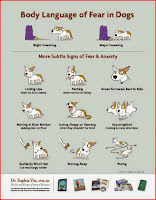
We can help keep our dogs and children safe by learning about dog body language.  Understanding what dogs are communicating to us allows us to advocate for our dogs, to mediate dog-child interactions, and to teach our children how to be safe and respectful around dogs.

We have a 2 1/2 year old son who is very active and loves dogs.

2021 Update:  Our son is now 8 1/2 and absolutely in love with all animals.

We encourage him to interact with our dogs and show his love for them by:
  • Helping us with feeding times (supervision means our hands are closer to the dog than his)
  • Playing "fetch" and/or throwing toys for the dog (parent is there to help cue "drop it" and to ensure toddler does not take toy from dog's mouth) 
  • Pet gently on the back or chest (again, parent's hands are on the dog as well and ensuring touch is gentle)
  • Asking her to "sit" and giving her a treat (with an open hand to avoid accidental nips)
We have the following expectations in how our child interacts with our dogs:
  • Hands are always gentle, no pulling on ears or tail, no grabbing, no hitting, no sitting or climbing on the dog, no hugging or kissing *this is very important.  Most dogs do not enjoy hugs or kisses and we do not want children's faces close enough to the dog to risk a bite
  • If a dog is sleeping or laying on a bed or in a kennel, they are not to be disturbed
  • If a dog has a bone she is behind a baby gate or in her kennel and cannot be reached by any children 
  • Once a dog has been released to eat her dinner, nobody touches the food or dishes (or Kong wobbler), the dog is left to eat in peace
Toddlers are toddlers, so they will not always adhere to these rules, and it is important that parents are actively supervising all interactions, being aware of our dog's body language and signals.  Toddlers are also silly and have lots of energy.  When our little guy is running around squealing, screaming, jumping up and down, and generally acting like a toddler does...  We provide a safe, quiet place for our dogs to get away, and/or we take one or both of them outside to burn off the energy :)  We really enjoy going for walks with both our son and dogs and it is a fun, safe way for them to bond.  


*Supervision cannot be effective unless we know what to look for.  

Here are some excellent resources:


Doggone Safe: http://www.doggonesafe.com

Family Paws: http://familypaws.com


www.familypaws.com


Dr. Sophia Yin:


http://info.drsophiayin.com/download-free-poster-how-kids-and-pets-should-not-interact/

Turid Rugaas: http://en.turid-rugaas.no/calming-signals-photos.html

http://en.turid-rugaas.no/calming-signals-photos.html


And for our local readers, the Winnipeg Humane Society has some excellent classes on safety with babies and dogs: http://www.winnipeghumanesociety.ca/pet-owners/classes-and-education/classes/dogs-storks/

As well as a workshop on dog body language: http://www.winnipeghumanesociety.ca/pet-owners/classes-and-education/classes/what-is-my-dog-saying/


In addition to the information above, Dr. Sophia Yin also has a dog body language poster available for download: http://info.drsophiayin.com/free-poster-on-body-language-in-dogs/ 

http://info.drsophiayin.com/free-poster-on-body-language-in-dogs/

Author's note:  This article was originally written for Bite Prevention Week 2015.  I attempted to ensure all links are valid, please contact me should you have any questions or find any broken links.  


2016 update:  The Winnipeg Humane Society has a Dogs & Toddlers course coming up on Thursday, May 26th from 7-9pm.  Visit their site for information on this and other great workshops and classes available: http://www.winnipeghumanesociety.ca/pet-owners/classes-and-education/classes/workshops-2/ 
http://www.winnipeghumanesociety.ca/pet-owners/classes-and-education/classes/workshops-2/dogs-toddlers/

Monday, 9 March 2015

5 Tips for Barking in the Home

Spring Fever?


Have you noticed that with the warmer weather this weekend the dogs have been barking more than during the deep freeze of winter?  I sure have!

With more smells in the air, more people and dogs out walking, and longer hours of daylight, there is more stimulation and excitement.

So what can you do about it?
  1. First and foremost, be proactive.  
    • What does that mean?  Keep your dog busy before he starts focusing on the neighbourhood kids walking home from school.  Before that bell rings fill a Kong, a Kong wobbler, or any other interactive food toy and keep your dog's focus on the ground rather than the window.  
    • Rather than waiting for the behaviour to happen and then calling your dog away from the trigger, get your dog's attention before it happens.  Ask for a "watch me", a "touch", a "go to your bed", a "go get your ball", anything your dog knows on cue that prevents him from focusing on that dog about to walk past your back lane.  
    • Put on some nice, calming music or talk radio to help drown out the sounds of the neighbour's dog barking in his yard, or the kids squealing in excitement as they run past. 
    • Put up a baby gate so that your dog has access to most of the house, but not the areas with the major triggers (i.e. the front window where all the action is).  The more he gets excited by all the activity, the more likely he is to bark.  The more he barks, the more excited he gets, and well you see how this can be a self-reinforcing behaviour. 
  2. Avoid escalation.
    • When you yell "hush!", "quiet!", and eventually "shaddup!!" (trust me, we've all been there), although it may feel satisfying for a moment and your dog may stop to look at you, two things happen:
      1. Your dog is interrupted for a moment then goes right back to barking.
      2. He says "hey, cool, my person is barking too, let's all bark together!"
    • Creating more noise in the environment can serve to increase the excitement or arousal levels and only increase the nuisance barking.
  3. Exercise!
    • We've all been watching the weather forecast, looking at our dog and saying "sorry, boy, way too cold today."  Finally, the milder weather is here and we can get out and enjoy it! A tired dog is more likely to relax and sleep than to bark, so get out there and have some fun with your pooch :) 
  4. Patience and Understanding.
    • Remember that barking is a 100% natural behaviour for dogs.  Some dogs enjoy barking more than others, and dogs bark for all kinds of reasons.  Although it can be a frustrating behaviour (especially when you just got your baby to bed and then Mr. Rover decides it's a good time to alert you to the neighbours pulling into your driveway...  hypothetically speaking, of course...) - remember that your dog doesn't know you have a migraine or that you have a report due in the morning and need to focus. 
  5. Most importantly, catch your dog being good! 
    • You've been laying on the couch reading a book while Rover lays nearby snoozing.  Suddenly something grabs his attention and he's up and barking and you get up and clap your hands, tell him SHUSH, and then go back to reading.  Now Rover has been ignored for laying quietly and potentially reinforced (he got your attention, didn't he?) for being loud.  
    • Instead, keep some treats stashed out of reach around the house.  When Rover is laying calmly and quietly, walk by and drop a treat under his nose.  Catch him doing what you want, reward the desired behaviours, and you'll get more of them. 


Visit our website at https://PawsitiveCare.ca


Visit us on Facebook at Facebook.com/PawsPooch


2017 Edit:  See our expanded post on managing barking! 
http://pawsitivepooch.blogspot.ca/2016/06/barking-talkative-dog.html