Monday, 9 March 2015

5 Tips for Barking in the Home

Spring Fever?


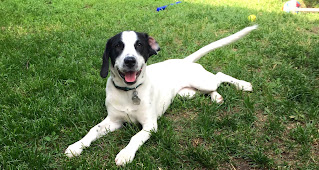
Have you noticed that with the warmer weather this weekend the dogs have been barking more than during the deep freeze of winter?  I sure have!

With more smells in the air, more people and dogs out walking, and longer hours of daylight, there is more stimulation and excitement.

So what can you do about it?
  1. First and foremost, be proactive.  
    • What does that mean?  Keep your dog busy before he starts focusing on the neighbourhood kids walking home from school.  Before that bell rings fill a Kong, a Kong wobbler, or any other interactive food toy and keep your dog's focus on the ground rather than the window.  
    • Rather than waiting for the behaviour to happen and then calling your dog away from the trigger, get your dog's attention before it happens.  Ask for a "watch me", a "touch", a "go to your bed", a "go get your ball", anything your dog knows on cue that prevents him from focusing on that dog about to walk past your back lane.  
    • Put on some nice, calming music or talk radio to help drown out the sounds of the neighbour's dog barking in his yard, or the kids squealing in excitement as they run past. 
    • Put up a baby gate so that your dog has access to most of the house, but not the areas with the major triggers (i.e. the front window where all the action is).  The more he gets excited by all the activity, the more likely he is to bark.  The more he barks, the more excited he gets, and well you see how this can be a self-reinforcing behaviour. 
  2. Avoid escalation.
    • When you yell "hush!", "quiet!", and eventually "shaddup!!" (trust me, we've all been there), although it may feel satisfying for a moment and your dog may stop to look at you, two things happen:
      1. Your dog is interrupted for a moment then goes right back to barking.
      2. He says "hey, cool, my person is barking too, let's all bark together!"
    • Creating more noise in the environment can serve to increase the excitement or arousal levels and only increase the nuisance barking.
  3. Exercise!
    • We've all been watching the weather forecast, looking at our dog and saying "sorry, boy, way too cold today."  Finally, the milder weather is here and we can get out and enjoy it! A tired dog is more likely to relax and sleep than to bark, so get out there and have some fun with your pooch :) 
  4. Patience and Understanding.
    • Remember that barking is a 100% natural behaviour for dogs.  Some dogs enjoy barking more than others, and dogs bark for all kinds of reasons.  Although it can be a frustrating behaviour (especially when you just got your baby to bed and then Mr. Rover decides it's a good time to alert you to the neighbours pulling into your driveway...  hypothetically speaking, of course...) - remember that your dog doesn't know you have a migraine or that you have a report due in the morning and need to focus. 
  5. Most importantly, catch your dog being good! 
    • You've been laying on the couch reading a book while Rover lays nearby snoozing.  Suddenly something grabs his attention and he's up and barking and you get up and clap your hands, tell him SHUSH, and then go back to reading.  Now Rover has been ignored for laying quietly and potentially reinforced (he got your attention, didn't he?) for being loud.  
    • Instead, keep some treats stashed out of reach around the house.  When Rover is laying calmly and quietly, walk by and drop a treat under his nose.  Catch him doing what you want, reward the desired behaviours, and you'll get more of them. 


Visit our website at https://PawsitiveCare.ca


Visit us on Facebook at Facebook.com/PawsPooch


2017 Edit:  See our expanded post on managing barking! 
http://pawsitivepooch.blogspot.ca/2016/06/barking-talkative-dog.html 

Saturday, 27 December 2014

Dispelling Reactive Dog Myths

3 Myths About Reactive Dogs 


What is a Reactive Dog? 

Reactive dogs are often the ones you see pulling to the end of their leash, lunging and barking towards another dog or some other “trigger” (such as a strange person or object on the street).   Many classify these dogs as aggressive, and yes, their behaviour is an aggressive display.  However, many of these dogs are sweet as can be when they’re in their comfort zones away from those triggers.  

There are a few harmful myths about these dogs and their owners, so I want to address three of them here.  

Myth #1 - Owners with reactive dogs are the cause of their dog’s behaviour 

Many of the owners with whom I have worked adopted these “problem” dogs when no one else would.  Many of them put in a great deal of time, effort, and money into helping their dogs overcome their fears.  They have worked with private trainers, attended classes, and some walk their dogs late at night or very early in the morning in order to avoid the triggering situations.  

Sometimes the triggers are well-meaning people who allow their dogs to greet these reactive dogs without first asking permission.  Owners of reactive dogs are often embarrassed by their dog’s behaviour, feel helpless when their dog is acting this way, and are trying their best.  You can help by removing the trigger (i.e. if your dog is the trigger, move away and out of their sight if possible) and always ask permission before allowing your dog to greet another.  

Myth #2 - Reactive dogs are “dominant” or inherently mean

Nope.  The primary and most common contributor to reactive behaviour is fear.  Lunging, growling, and barking are distance-increasing behaviours, meaning it’s the way the dog says “please leave me alone, you are scaring me!”  They are trying to make themselves look and sound scary in order to make whatever they perceive as threatening go away.  These dogs are usually more insecure, anxious, or fearful and these traits have nothing at all to do with dominance.  

Myth #3 - Rewarding Fear Increases that Fear

You cannot operantly condition fear.  This means if you comfort your dog when he is afraid, you are not rewarding the fear and you are not making it worse, you are helping him feel better and helping him make a positive association with the scary object.

Donna Hill has a great YouTube video on a game called "Look at That":


The above exercise was adapted from Leslie McDevitt's book "Control Unleashed".

On the same note, you can absolutely not punish fear out of the dog.  Putting a shock collar or prong collar on your dog and causing him pain whenever he is reacting will either suppress the behaviour, making him a greater bite risk because he no longer gives warning signs, or it will make his aggressive display much worse.  If a dog is afraid of other dogs and receives a poke or shock whenever he sees another dog, he will associate pain with other dogs and his fear will increase.  This is classical conditioning, a learning process that occurs when two stimuli are repeatedly paired together.  

Fear is classically conditioned and not operantly conditioned, meaning fear is conditioned when two stimuli (i.e. treats and nail clippers) happen in close proximity, allowing the dog to make a connection between the two.  If we pair a scary object with something good (i.e. a yummy Kong whenever there is a thunderstorm), it helps decrease the fear.  


Come to think of it, a lot of really skilled and knowledgeable trainers I know have reactive dogs.  This is usually because no one else had the skill or ability to work with these dogs, so they are adopted by experts.  However, it takes a great deal of hard work, commitment, and management to help a dog overcome his fears.  Each time we unexpectedly encounter an off-leash dog where he’s not supposed to be, or have someone allow their dog to approach ours when we are asking them not to, it sets our progress back and is very stressful for the dog.  And no matter how skilled we are or how hard we work, we cannot change a dog’s DNA. 

To my friends, colleagues, and clients who have reactive or fearful dogs: thank you for having the patience and kindness to help these dogs whose lives can be very stressful.  It may add stress to your life, but when we see progress and know we are making their lives a little better, it makes all the hard work so worth it.  


About the writer: 


Jillian Enright moved from Toronto in 2007 and spent her first four years studying Psychology with an emphasis on Animal Learning & Behaviour at the University of Winnipeg.  

Jillian is a Certified Professional Dog Trainer (CPDT-KA), meaning her knowledge on animal learning theory, husbandry, health, ethology, training equipment, and instructing skills have all been evaluated to the standard of the Certification Council for Professional Dog Trainers.  This also includes adherence to a code of ethics and to the humane hierarchy for animal training.  


Jillian has a strong academic background in training in addition to practical experience, including running her own highly successful Dog Walking & Sitting business called Sturgeon Park Dog Care 


Jillian also worked as a Behaviour Counsellor for the Winnipeg Humane Society doing behavioural assessments, behaviour modification, and clicker training.  

Jillian trains using an evidence-based approach including classical & operant conditioning and positive reinforcement.  "Pawsitive" means training is done without the use of any force, intimidation, or punishment.  No shock collars, choke chains, or prong collars are needed to implement a successful training program.  

Training should be both successful and FUN - for both owner and dog!

Saturday, 29 November 2014

Frosty Whiskers and the Hypothermic Half-Marathon!

Fundraising for the Winnipeg Humane Society


2017/2018 update:


In February 2018, Jillian will be joining some brave colleagues from The Winnipeg Humane Society to run in Manitoba winter weather!  Some will be doing the Half-marathon, and some of us will be trying to beat our best time in the 10K.  

You can donate directly to this fundraiser on the Winnipeg Humane Society's webpage 

Stay tuned to the Frosty Whiskers' Facebook page and the Pawsitive Pet Care Facebook page for exciting fundraising goals and updates!  


Original Post from November 29 2014:


Those who know me know I am a coffee addict. Recent increases in coffee prices had me thinking: I spend a good $2 every single day buying drive-thru coffee. That comes to at least $60/month!  It just so happens that my wonderful co-workers on the Behaviour Team at the The Winnipeg Humane Society are doing the Hypothermic Half Marathon in support of the WHS on February 22nd. I have decided that, starting today, I will brew my coffee at home and set $2 aside each day to donate towards this worthwhile cause. That's 85 days, $2 per day, equalling $170 to help animals in the care of the WHS! 


My last drive-thru coffee for 85 days.


I welcome anyone who wants to help fundraise for this worthwhile cause to join me.  Please donate at http://www.gofundme.com/frostywhiskers and share this page to help our animals in need.  It costs an average of $400 PER DOG in the care of the WHS and they rely solely on donations from the generous public. Thank you and happy training 

Learn more by visiting the Frosty Whiskers on Facebook: https://www.facebook.com/Frostywhiskers

 And visit our Facebook page at Facebook.com/PawsPetMB