|
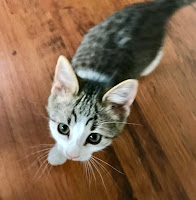
| "Can we go out yet?" |
Threshold Training
The goal of these exercises is to teach your pet that they do not automatically go through a doorway when a door is opened and they should wait until you give them permission to move forward. This is important for your pet's safety and is an extremely important skill for all dogs to learn, especially door-dashers. Door-dashing cats definitely benefit from this training as well, we'll focus on dogs here, but the Cat Behaviour Associates website has fantastic resources for cat behaviour.

Waiting in a Controlled Position
It is easier for your dog to wait if they are in a control position (sitting or lying down). Ask your dog to sit or down, whichever they do best; the focus is not on sit/down, but on waiting and on impulse control.
For cats, you can often do what we call "station training" and have them up on a cat tree. Pam Johnson-Bennett has a great article on door-darting on her website that focuses exclusively on cat behaviour.
Choose a safe doorway within your home and have your dog sit or lay down by your side. Similar to your “stay” cue, gently move your hand in front of your dog, or put up one finger, and say “wait”.

Desensitization
Most dogs associate their person touching a doorknob with the door being opened and will jump up or run toward the door as soon as our hand reaches toward the doorknob. Before we even begin door training, we need to desensitize our dog to this process. Currently your dog may have the association of door knob touch = rush the door. What we want to do is teach him to remain in place when we touch the door knob and then open the door, and make waiting more rewarding than rushing.
It can be easiest to have a mat or dog bed near the door to give your dog a visual cue for where he is supposed to wait. If you have a threshold that changes flooring type (i.e. a hardwood or carpet that transitions to vinyl), then using that line can also be a good spot to start.
Have your dog in his control position (down/sit), ask him to "wait", then put up a finger (don't do it at the same time, use the verbal signal first, then the hand signal). Move your hand to touch the doorknob. If he jumps up, return him to his place and his control position, then try again but move even more slowly. If he remains in place, move beside your dog, then reward him. It is important you return to your dog before giving him a treat so that he does not start moving toward you in anticipation of his treat.
Next, turn the doorknob and repeat the steps above. Then open the door a crack and repeat the steps above. Continue this until you can reliably open the door without your dog moving (meaning he doesn’t move at least 8 out of 10 times).
Step 2 : Practice With the Door Open
Step one can take days or even weeks to perfect, so please do not rush the process. Take your time and set yourself and your dog up for success along the way. Your patience will pay off!
Now, with the door open, have your dog in his control position (down/sit), ask him to "wait", then put up a finger. Take one step toward the doorway. If your dog does not move, return to his side and give him a treat. If he does move, ask him to sit/down and try again but take a smaller step to make it a little easier for him.
Once you can take one step without your dog moving reliably (at least 8 out of 10 times he doesn’t move), ask your dog to sit/down & wait and take a step through the doorway. If he does not move, return to your dog and give him a treat. If he moves, ask him to sit or down and try again with a smaller step, perhaps stopping right on the threshold instead of going through the doorway first.
Choosing a Release Word
Once your dog understands the concept of "wait" and is reliably waiting while you take a big step fully through your doorway, you can then incorporate a release word. Your release word can be anything you choose. Remember, your dog does not speak English (or any other spoken language); he just makes associations between certain “sounds” (words), actions, and their consequences. A common release word is “okay”, but this is not always the best choice because we use the word “okay” a great deal in our everyday conversations. Other options are “break”, “alright”, “free”, or truly anything you choose. It can be in any language, or it can be gibberish, a made-up word, as long as you are consistent and everyone in your household will use the same word every time. I like to use a crisp, one-syllable word so that it is easy and clear for the dog.
Step 3 : Increase # of Steps
Once you can walk through the doorway without your dog moving, ask him dog to sit/down & wait and take two steps through the doorway. If he moves, ask him to sit or down and try again with only one step. If he does not move, return to your dog and give him a treat, and then release him! Remember: It’s important to reward him in his waiting place and not after you release him, so that he’s getting rewarded for staying there, and not for going through the door. His big reward will be getting to go where he wants to go – through the door, usually to the outside world. Slowly you will be able to reduce and then phase out the treats for waiting, and his reward will be the release and being allowed to go play in the yard, or out the front door to start his walk.
Step 4 : Generalize
Dogs are not good at generalization, so they need to practice new behaviours in as many different locations and scenarios as possible. Practice “wait” in various doorways throughout your house, including the bedrooms, bathrooms, and back door. Once you can walk through the doorways without your dog moving until you release him, move to the front door, but make sure your dog is on his leash for safety.

You can also practice "wait" at the bottom of the stairs, having him wait at the bottom until you get to the top before you release him, and then starting at the top and releasing him when you get to the bottom. This helps generalize the wait command and also promotes safety on the stairs, especially with those big dogs who like to rush past your legs while you're trying to go down the stairs!
Another very important place to practice "wait" is yard gates. If you have a fenced yard with gates that can be blown open, or left open accidentally, this is another important place where your dog should wait for a cue to proceed out.

Once he gets good at waiting, you can use a longer leash so that you can take more steps through the doorway before returning to him and releasing him. It is important you return to your dog before giving him a treat so that he does not start anticipating and moving before you are back by his side.
Remain Consistent
It is very important that once you start this training, you do not allow your dog out the front door without waiting for your permission. It may take a long time to leave the house for walks at first, but the hard work and patience will pay off, and it will become a habit for your dog to sit and wait at the door and to be invited out to start the walk.
Environmental Management
You can set both your dog and yourself up for success (and safety!) by using the environment around him to reduce or prevent the likelihood of getting out doors without waiting first. Use baby gates, closed doors, whatever you can to prevent access to frequently-used doorways to prevent any door dashing.

Proofing (Step 5): Door Dashing
Some dogs will try to push their way out the door when their owners are talking to a delivery person or getting the mail. With your dog on leash, have a friend, partner, or family member practice coming to the door and having a conversation with you with the door open just a bit while your dog is asked to wait on his bed or wait by your side. Start with the door only open a crack and slowly practice with the door opened a little more each time, again, always make sure your dog is on leash so you can keep him safe if he does try to sneak past you. You also want to prevent the opportunity for him to be rewarded by door-dashing, so even if you’re practicing on a garage door or back door, I still recommend using a leash.
Keep it Short & Sweet
Training sessions should be frequent, short, and fun. Cut up 10 very small pieces of your dog’s treats and do 10 reps or practice during commercial breaks while watching television. Keep sessions only to a minute or two so that you end with your dog wanting more, don’t over-train until he’s tired of the game and no longer engaged. Remember that puppies’ attention spans are even shorter, and they wear out faster!
Reward heavily for your dog waiting successfully! It’s hard work for him to fight the urge to run free and explore the outdoors, so make sure that you make waiting inside a very pleasant event for him by using high-value (and high-value is determined by your dog’s preferences) treats. Most importantly, have fun!