Showing posts with label Dog Safety. Show all posts

Sunday, 8 October 2017

Hallowe'en with Pets


Tips for keeping your pets safe and reducing their stress at Hallowe’en. 


Have you ever come home wearing a new hat or sunglasses and had your dog react strangely to you until he realized who you were?  Dogs are very sensitive and perceptive to changes in their environment and, just like humans, dogs react to changes in different ways.  Some easy-going dogs might actually enjoy hallowe’en and the excitement of people coming and going, but please know that they are in the very small minority.

Many dogs will be quite afraid of the costumes and will be quite riled up by repeated knocks at the door or the ringing of the doorbell.  If your dog is in that majority, or if you're at all unsure, I recommend setting up a quiet room for him where he can relax. 

Here is the plan we follow:

  • During the day when it’s still light outside, we take the dogs for a nice long walk.  We enjoy the Fall colours and allow the dogs to sniff and explore, to get as much exercise and enrichment as possible before dusk.
  • We delay the dogs’ dinners until the Trick-or-Treaters start to come out and then we provide our dogs their dinners in stuffed Kongs.  For more about stuffing Kongs please visit our Thunder Phobia blog post and for other ideas for keeping your dog(s) entertained, please visit our Boredom Busters blog post. 
  • Our dogs are kennel trained, so they go into their kennels (as far as possible from the front door) once the costumed children start arriving.  If your dog is not content in a kennel you can use an X-Pen or a quiet room with the door closed.  We put on some calming music or talk radio to help drown out the sounds.
  • One of us is on “door duty”.  We keep the front door within our view, so we can see the kids coming before they ring the doorbell, and show up with their candy before they’ve had a chance to knock.

If you have kids who will be dressing up, or if you like to dress up yourself, I highly recommend allowing your dog to get used to the costumes well in advance.  Put on different pieces of the costume (start with the bottom and work your way up so your dog can still see it’s you) and give your dog treats or play with him for a little while, then take it off again.  Later add another piece of the costume and do the same, and so on, until your dog has seen you in the full costume.  If you’re wearing a mask or something that covers your face let your dog watch you put it on so he sees the change in front of him, then give him his very favourite treat then remove the mask quickly.

For cats, consider a safe room as well.  If you are opening your door repeatedly it is possible your cat could sneak out, then get spooked with all the costumes, and it could be difficult to get her back home.  This could be very traumatic for your kitty and for your family!

Hallowe’en only comes once a year, so if you don’t need your pets to get used to the costumes, the bright lights, the sounds, the scary music, the kids screaming, and so on, consider giving them a safe space and letting him skip this strange human custom altogether.

For more tips and information on Halloween with pets, please visit Family Paws’ blog post on the topic at https://www.familypaws.com/halloween-and-hounds/

Happy Hallowe’en!


 To learn more about us, please visit us on Facebook at Facebook.com/PawsPetMB


 and visit our website at www.PawsitiveCare.ca 

Thursday, 23 July 2015

Preventing Heat Stroke in Your Dog


Preventing Heat Stroke in Your Dog

Originally written July 23, 2015

Today's heat advisory has brought back to the forefront our hot weather policies and preventing heat stroke in the dogs we walk. 


Here are some of our tips to help keep your dog safe when it's very hot and humid out:

  • When the schedule allows, set the dog walk up for earlier in the day, when it's cooler 
  • Provide a portable water carrier so your dog-walker can offer water to your dog throughout the walk 
    • It is advisable that each dog have their own water bottle or bowl to prevent the spread of disease or illness 
  • Dog walkers will take breaks in the shade and monitor the dog for signs that he needs a break.  Some early signs are:
    • Panting more heavily
    • Trying to search for shade and/or water, pulling towards trees or cooler areas
    • Walking more slowly
    • Thicker, more sticky saliva
  • There are signs of more severe hyperthermia (heat stroke), however we advise being proactive and preventing the dog from getting to that point.  An article on the more serious signs and what to do in a heat stroke emergency is available on the Pet Education blog
With regards to our professional dog-walking service, our policy is that when the temperature reaches 35 degrees Celsius or higher with the humidity index, we reduce walks to 20 minutes or less, or 20-minute intervals for hour-long walks.  

We will remain with your dog for the full scheduled visit, but will bring the dog back home to cool off, drink water, and can play games inside or snuggle and spend time with your dog in ways that they enjoy.  If the walk is a full hour, we can go back out again for a final opportunity for a potty break and a little more walking before we leave.  

If your dog is particularly sensitive to the heat, please let us know so that we can be especially vigilant and plan for more breaks in the shade or a shorter walk if needed. 

We can also do water play in your back yard if you have a pool or other water toys for your dog.  


Clients can also provide stuffed frozen Kongs or other cool treats for your dog to snack on when you are away.  If you leave a Kong or frozen treat in your freezer we are more than happy to offer it at the end of our walk.  For suggestions on preparing frozen Kongs, see our Kong Stuffing Blog Post.


If it's just too hot to take your dog out for longer than a potty break, check out our Boredom Busters blog for ideas to keep your dog entertained in the house.  

All of our dog-walkers and pet-sitters are trained in Emergency Pet First Aid.  We never transport your dogs in our vehicles without your express written consent, and dogs are never left unattended in vehicles.  


Manitoba Parks also has a Paws in Parks webpage with a list of dog-friendly activities in the province, including a list of dog-friendly swimming areas:

Click for enlarged image

Enjoy the summer and stay safe! - Don't forget water for the humans too :) 


More more informative blog posts, visit our main page at PawsitivePooch.BlogSpot.com
www.PawsitivePooch.BlogSpot.ca


Tuesday, 19 May 2015

National Dog Bite Prevention Week!

Originally posted in 2015
We can help keep our dogs and children safe by learning about dog body language.  Understanding what dogs are communicating to us allows us to advocate for our dogs, to mediate dog-child interactions, and to teach our children how to be safe and respectful around dogs.

We have a 2 1/2 year old son who is very active and loves dogs.

2021 Update:  Our son is now 8 1/2 and absolutely in love with all animals.

We encourage him to interact with our dogs and show his love for them by:
  • Helping us with feeding times (supervision means our hands are closer to the dog than his)
  • Playing "fetch" and/or throwing toys for the dog (parent is there to help cue "drop it" and to ensure toddler does not take toy from dog's mouth) 
  • Pet gently on the back or chest (again, parent's hands are on the dog as well and ensuring touch is gentle)
  • Asking her to "sit" and giving her a treat (with an open hand to avoid accidental nips)
We have the following expectations in how our child interacts with our dogs:
  • Hands are always gentle, no pulling on ears or tail, no grabbing, no hitting, no sitting or climbing on the dog, no hugging or kissing *this is very important.  Most dogs do not enjoy hugs or kisses and we do not want children's faces close enough to the dog to risk a bite
  • If a dog is sleeping or laying on a bed or in a kennel, they are not to be disturbed
  • If a dog has a bone she is behind a baby gate or in her kennel and cannot be reached by any children 
  • Once a dog has been released to eat her dinner, nobody touches the food or dishes (or Kong wobbler), the dog is left to eat in peace
Toddlers are toddlers, so they will not always adhere to these rules, and it is important that parents are actively supervising all interactions, being aware of our dog's body language and signals.  Toddlers are also silly and have lots of energy.  When our little guy is running around squealing, screaming, jumping up and down, and generally acting like a toddler does...  We provide a safe, quiet place for our dogs to get away, and/or we take one or both of them outside to burn off the energy :)  We really enjoy going for walks with both our son and dogs and it is a fun, safe way for them to bond.  


*Supervision cannot be effective unless we know what to look for.  

Here are some excellent resources:


Doggone Safe: http://www.doggonesafe.com

Family Paws: http://familypaws.com


www.familypaws.com


Dr. Sophia Yin:


http://info.drsophiayin.com/download-free-poster-how-kids-and-pets-should-not-interact/

Turid Rugaas: http://en.turid-rugaas.no/calming-signals-photos.html

http://en.turid-rugaas.no/calming-signals-photos.html


And for our local readers, the Winnipeg Humane Society has some excellent classes on safety with babies and dogs: http://www.winnipeghumanesociety.ca/pet-owners/classes-and-education/classes/dogs-storks/

As well as a workshop on dog body language: http://www.winnipeghumanesociety.ca/pet-owners/classes-and-education/classes/what-is-my-dog-saying/


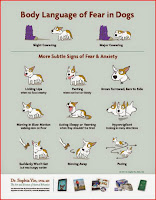
In addition to the information above, Dr. Sophia Yin also has a dog body language poster available for download: http://info.drsophiayin.com/free-poster-on-body-language-in-dogs/ 

http://info.drsophiayin.com/free-poster-on-body-language-in-dogs/

Author's note:  This article was originally written for Bite Prevention Week 2015.  I attempted to ensure all links are valid, please contact me should you have any questions or find any broken links.  


2016 update:  The Winnipeg Humane Society has a Dogs & Toddlers course coming up on Thursday, May 26th from 7-9pm.  Visit their site for information on this and other great workshops and classes available: http://www.winnipeghumanesociety.ca/pet-owners/classes-and-education/classes/workshops-2/ 
http://www.winnipeghumanesociety.ca/pet-owners/classes-and-education/classes/workshops-2/dogs-toddlers/